What Is a Fractal?
A fractal is a geometric shape that exhibits self-similarity at every level of magnification. Unlike the smooth curves and straight edges of classical Euclidean geometry, a fractal contains intricate detail no matter how far you zoom in. Each smaller portion of the structure mirrors the complexity of the whole, creating an infinitely recursive pattern generated from surprisingly simple mathematical rules.
The word "fractal" comes from the Latin fractus, meaning broken or fragmented. This is fitting because fractals describe the rough, irregular shapes that dominate the real world: jagged coastlines, branching trees, turbulent clouds, and craggy mountain ridges. Classical geometry struggles to model these forms, but fractal geometry captures their essence by embracing roughness and recursion rather than trying to smooth them away.
Three core properties define a fractal. First, self-similarity: the pattern repeats at progressively smaller scales, either exactly or statistically. Second, infinite complexity: no matter how closely you examine a fractal, new detail continues to emerge. Third, fractional dimension: a fractal occupies a dimensional space between whole numbers. A coastline, for instance, is more complex than a one-dimensional line but does not fill a two-dimensional plane, so its fractal dimension falls somewhere between 1 and 2.
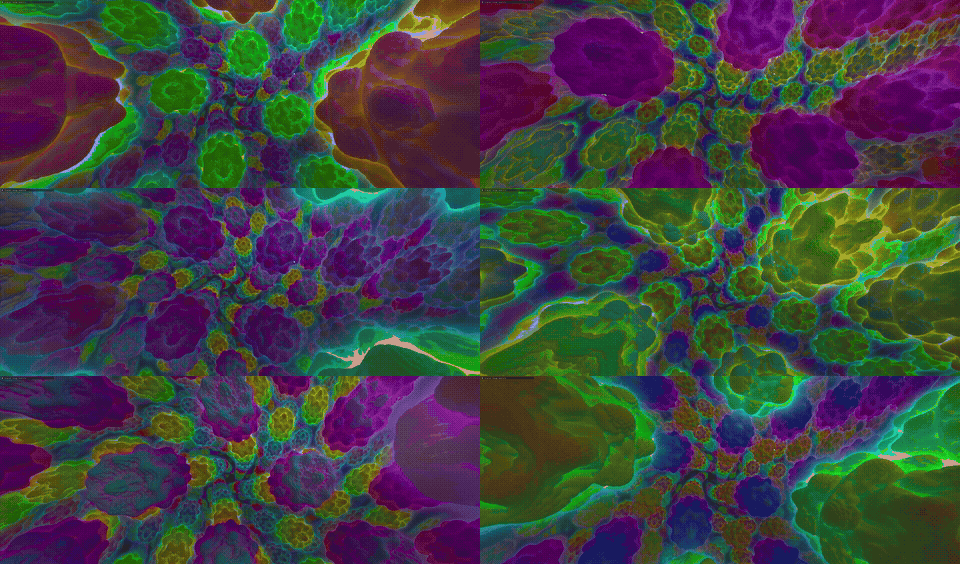
What makes fractals so remarkable is that extraordinary visual complexity arises from the repeated application of simple equations. A handful of mathematical operations, iterated thousands or millions of times, can produce structures of breathtaking beauty and endless variety. This property has made fractals central to computer graphics, scientific simulation, data compression, and artistic expression.
The History of Fractals
Although self-similar structures were observed long before anyone had a name for them, the formal study of fractal geometry began in the late 19th century with a series of mathematical curiosities. In 1883, Georg Cantor devised the Cantor set by repeatedly removing the middle third of a line segment, creating a dust of infinitely many points with zero total length. It was one of the first demonstrations that simple iterative rules could produce counterintuitive, infinitely detailed structures.
Helge von Koch followed in 1904 with the Koch snowflake, a curve of infinite length enclosing a finite area. Starting with an equilateral triangle, Koch replaced each straight edge with a smaller triangular bump, then repeated the process on every new edge, forever. The resulting shape has no tangent line at any point, defying the assumptions of calculus and hinting at a deeper geometry beneath classical mathematics.
Waclaw Sierpinski contributed the Sierpinski triangle in 1915, a pattern formed by recursively removing inverted triangles from a solid shape. Like the Cantor set and Koch curve, it demonstrated that iteration could generate objects with strange dimensional properties. These early examples remained mathematical curiosities for decades, lacking a unifying framework.
That framework arrived when Benoit Mandelbrot published The Fractal Geometry of Nature in 1982. Mandelbrot coined the term "fractal" in 1975 and argued that these recursive, self-similar shapes were not exotic exceptions but the default geometry of the natural world. His eponymous Mandelbrot set became the most famous fractal of all, a seemingly simple equation whose boundary contains infinite, never-repeating complexity. Mandelbrot's work launched fractal geometry as a new branch of mathematics with applications spanning physics, biology, finance, computer science, and art.
Fractals in Nature
One of the most compelling aspects of fractal geometry is how frequently self-similar patterns appear in the natural world. Nature does not build with rulers and protractors; it builds through growth processes that repeat at different scales, and those processes generate fractal structures almost inevitably.
Romanesco broccoli is perhaps the most visually striking natural fractal. Each floret is a miniature copy of the whole head, arranged in a logarithmic spiral that repeats across multiple levels of scale. The pattern is so regular that it serves as a textbook illustration of self-similarity in biology.
Fern leaves demonstrate a related phenomenon. A single fern frond is composed of smaller leaflets, and each leaflet is itself a tiny replica of the entire frond. This recursive branching continues down through several generations, creating the delicate, layered appearance that makes ferns instantly recognizable. Mathematically, ferns can be modeled with remarkable accuracy using iterated function systems, a class of fractal algorithms.
Coastlines were the natural feature that first inspired Mandelbrot's investigations. He observed that the measured length of a coastline depends on the scale of measurement: shorter rulers capture more crevices and inlets, yielding a longer total length. This paradox, known as the coastline problem, is a direct consequence of the fractal geometry of shorelines. A coastline's fractal dimension quantifies its roughness and typically falls between 1.1 and 1.5.
Other natural fractals include lightning bolts, which branch recursively as electrical discharge seeks the path of least resistance; snowflakes, whose six-fold symmetric arms develop through crystallization into fractal patterns; river networks, where tributaries feed into streams that feed into rivers in a self-similar branching hierarchy; and the human lung, whose bronchial tree branches approximately 23 times to pack an enormous surface area into a compact space. Each example underscores the same principle: repeated, scale-independent growth processes produce fractal patterns as a natural consequence of physics and biology.
Mathematical Properties of Fractals
The mathematics behind fractal geometry can be profound, but the foundational ideas are accessible to anyone willing to think about shapes and repetition. Three properties stand at the center of what makes a fractal different from an ordinary geometric figure.
Self-similarity is the hallmark of every fractal. In an exactly self-similar fractal like the Sierpinski triangle, each small piece is a perfect, scaled-down replica of the whole. In a statistically self-similar fractal like a coastline, the small pieces are not identical copies but share the same statistical character: the same roughness, the same distribution of features, the same overall feel at every scale.
Fractional dimension gives fractals their name and their mathematical power. In Euclidean geometry, a line is one-dimensional, a plane is two-dimensional, and a solid is three-dimensional. Fractals break this tidy scheme. The Koch snowflake curve, for example, has a fractal dimension of approximately 1.26. It is more space-filling than a line but less than a plane. The concept of fractional dimension, formalized through Hausdorff dimension and box-counting methods, provides a precise way to measure the complexity and space-filling tendency of irregular shapes.
Iteration is the engine that drives fractal generation. A fractal is not drawn in one step; it emerges from the repeated application of a rule or equation. Take a starting value, apply a formula, feed the result back in, and repeat. After thousands of iterations the outcome either diverges to infinity, settles into a cycle, or traces a complex boundary. This feedback loop is the mechanism behind the Mandelbrot set, Julia sets, and most other mathematical fractals. The simplicity of the rule and the complexity of the result are what make fractals so fascinating.
Together, these properties mean that fractal geometry provides a language for describing irregular, rough, and fragmented shapes that classical geometry cannot handle. It is a geometry of clouds rather than spheres, of mountains rather than cones, of real landscapes rather than idealized models.
Types of Fractals
Fractal geometry encompasses a rich variety of structures, each generated by a different class of algorithm. Understanding the main types provides a map of the fractal landscape and reveals the versatility of self-similar mathematics.
Iterated Function Systems (IFS) generate fractals by applying a set of contractive transformations and combining the results. The Sierpinski triangle and the Barnsley fern are classic IFS fractals. Each transformation scales, rotates, or translates a piece of the image, and the union of all transformed copies converges to the final fractal shape. IFS fractals are widely used in data compression because they can encode complex images with a small set of simple transformations.
Escape-time fractals are built by iterating a function at every point on a grid and coloring each point according to how quickly the sequence diverges. The Mandelbrot set is the most famous example: for each complex number c, the iteration z = z² + c either stays bounded or escapes to infinity, and the boundary between these two behaviors is an infinitely complex fractal curve. Julia sets are close relatives, generated by fixing c and varying the starting point. Escape-time algorithms produce the vivid, psychedelic images most people associate with the word "fractal."
Strange attractors emerge from dynamical systems that exhibit chaotic behavior. The Lorenz attractor, discovered during weather modeling, traces a butterfly-shaped trajectory that never exactly repeats yet remains confined to a fractal-dimensional surface. The Rossler attractor and Henon map are other well-known examples. Strange attractors reveal fractal structure in time-evolving systems and connect fractal geometry to chaos theory.
L-systems, or Lindenmayer systems, use string-rewriting rules to model biological growth. Starting from a simple axiom, each character in the string is replaced according to production rules, and the resulting string is interpreted as a sequence of drawing commands. L-systems elegantly reproduce the branching patterns of trees, shrubs, algae, and flowers, bridging fractal mathematics and computational biology.
Fractals and Music Visualization
The mathematical properties that make fractals endlessly intricate also make them ideal canvases for real-time audio visualization. Because fractal algorithms are controlled by numerical parameters, those parameters can be driven by audio data, creating a living, breathing visual response to music.
In a typical fractal music visualizer, the audio stream is analyzed in real time to extract features such as frequency spectrum, bass amplitude, treble energy, beat onsets, and overall loudness. These values are then mapped to fractal rendering parameters: zoom level, rotation angle, color palette offset, iteration depth, and transformation coefficients. When a bass drum hits, the fractal might pulse outward. When a melody climbs, the color palette might shift through warm hues. The result is a visual experience that feels intimately connected to the music.
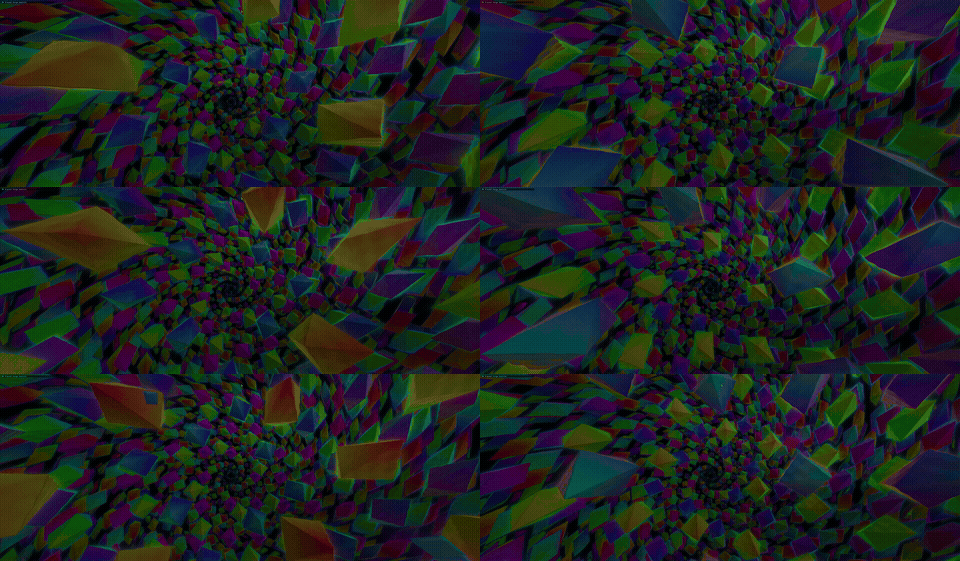
This approach exploits the sensitivity of fractal algorithms to small parameter changes. A tiny shift in one coefficient can transform the entire visual structure, creating dramatic, fluid transitions that mirror the dynamics of a song. The infinite detail of fractal geometry ensures that the visuals never become repetitive or predictable, even during long performances or listening sessions.
Fractal Forge Native applies these principles with 53 distinct fractal types, each responding to audio input through GPU-accelerated rendering. From the classic Mandelbrot set to Julia sets, flame fractals, and strange attractors, every algorithm transforms sound into fractal art in real time. The software analyzes your system audio and maps it across multiple visual parameters simultaneously, producing an audio-reactive fractal visualization that is different every time you listen.
The marriage of fractal mathematics and music visualization represents one of the most compelling modern applications of fractal geometry. It transforms abstract equations into immersive sensory experiences and makes the beauty of fractal patterns accessible to anyone with a pair of speakers and a sense of wonder.
Frequently Asked Questions About Fractals
What is a fractal?
A fractal is a geometric shape that displays self-similar patterns at every level of magnification. Fractals are characterized by infinite complexity, fractional dimensions, and emergence from simple iterative rules. They describe the rough, irregular shapes found throughout nature and mathematics that classical Euclidean geometry cannot represent.
Where are fractals found in nature?
Fractals appear throughout the natural world. Common examples include the branching structure of fern leaves, the spiraling florets of Romanesco broccoli, the jagged contours of coastlines, the branching paths of lightning bolts, the symmetry of snowflakes, the dendritic networks of rivers, and the repeatedly branching airways of the human lung. These patterns arise because natural growth processes repeat at different scales.
Who discovered fractals?
Benoit Mandelbrot coined the term "fractal" in 1975 and is credited with establishing fractal geometry as a formal branch of mathematics. However, earlier mathematicians laid essential groundwork. Georg Cantor described the Cantor set in 1883, Helge von Koch introduced the Koch snowflake in 1904, and Waclaw Sierpinski defined the Sierpinski triangle in 1915. Mandelbrot unified these ideas and demonstrated their relevance to the real world.
What are fractals used for?
Fractals have applications across many fields. In computer graphics, they generate realistic terrain, vegetation, and textures. In telecommunications, fractal antenna designs achieve broadband performance in compact sizes. Medical imaging uses fractal analysis to study tissue structures and detect abnormalities. Financial analysts model market behavior with fractal methods. Data compression algorithms exploit fractal self-similarity to reduce file sizes. Artists and musicians use fractal algorithms to create generative art and real-time music visualizations.
How do fractals relate to music?
Fractal algorithms can be driven by audio data in real time, mapping musical properties like frequency, amplitude, and rhythm to visual parameters such as zoom, rotation, color, and iteration depth. This creates dynamic visualizations that respond to every beat and melody. Software like Fractal Forge Native uses GPU-accelerated fractal rendering to transform system audio into living fractal art across 53 different fractal types.