What Is the Mandelbrot Set?
The Mandelbrot fractal is arguably the most recognizable image in all of mathematics. At its heart lies a single iterative equation: z = z² + c. Starting with z = 0, you pick a complex number c and apply this formula over and over. If the sequence stays bounded — never flying off toward infinity — then c belongs to the Mandelbrot set. If the sequence escapes, c sits outside the set, and the speed of its escape is mapped to a color.
What makes the Mandelbrot set extraordinary is not the interior, which is simply a solid region on the complex plane, but the boundary. This boundary is infinitely detailed: no matter how far you zoom in, you find spirals, tendrils, miniature copies of the whole set, and structures that defy any finite description. This property — self-similarity at every scale — is what defines it as an escape-time fractal and one of the purest examples of fractal geometry.
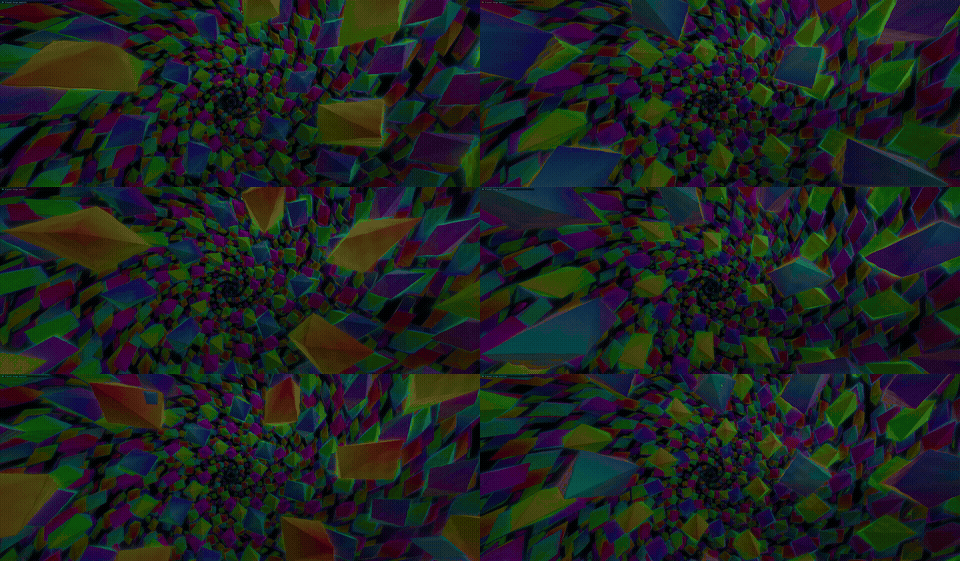
Mathematicians classify the Mandelbrot set as a connected set: it is a single, unbroken piece, despite the infinitely intricate filaments that decorate its edges. This was proven rigorously by Adrien Douady and John Hubbard in the early 1980s and remains one of the cornerstones of complex dynamics.
Benoit Mandelbrot and the Birth of Fractal Geometry
The Mandelbrot fractal takes its name from Benoit B. Mandelbrot (1924–2010), the Polish-born, French-American mathematician who coined the word “fractal” in 1975. Working at IBM’s Thomas J. Watson Research Center, Mandelbrot had access to computing resources that allowed him to visualize mathematical objects in ways that were previously impossible. His 1982 book, The Fractal Geometry of Nature, argued that the irregular shapes found in coastlines, clouds, mountains, and blood vessels were not random anomalies — they were fractals, governed by recursive self-similar processes.
The set that bears his name was first studied by the French mathematicians Pierre Fatou and Gaston Julia in the early twentieth century, but it was Mandelbrot who, using computer graphics, revealed the stunning visual complexity hiding inside the iteration z = z² + c. His work transformed fractal geometry from an abstract curiosity into a tool used across physics, biology, finance, and art. To learn more about the broader world of fractal geometry, see our guide on what a fractal is and why it matters.
How the Mandelbrot Set Is Calculated
Computing the Mandelbrot fractal is remarkably straightforward, which is part of its appeal. Every pixel on screen corresponds to a point c on the complex plane, where the horizontal axis is the real part and the vertical axis is the imaginary part. For each pixel, you perform the following loop:
- Set z = 0.
- Compute z = z² + c.
- Check whether the magnitude of z exceeds the escape radius (typically 2). If it does, stop and record the iteration count.
- If the magnitude stays below the escape radius, repeat step 2 up to a maximum number of iterations.
Points that never escape are colored black (or another solid color) to indicate membership in the set. Points that escape are assigned a color based on the iteration count at which they diverged. This is why the Mandelbrot fractal is classified as an escape-time fractal — the visual output is a direct mapping of how quickly each point escapes.
The complex numbers involved are nothing exotic: each number c has the form a + bi, where a is the real component, b is the imaginary component, and i is the square root of −1. Squaring a complex number and adding another is just a few multiplications and additions, yet this minimal arithmetic generates structures of astonishing depth. Increasing the maximum iteration count reveals finer detail at deeper zoom levels, which is why GPU acceleration matters — modern graphics cards can evaluate billions of iterations per second, rendering the Mandelbrot set in real time at high resolution.
Mandelbrot and Julia Sets
The Mandelbrot set and Julia sets are two sides of the same coin. Both use the identical formula z = z² + c, but they differ in what is held constant and what varies. When generating the Mandelbrot fractal, c changes for each pixel while z always starts at 0. When generating a Julia set, c is fixed to a single value and z starts at the pixel coordinate instead.
This relationship creates a deep correspondence: every point inside the Mandelbrot set produces a connected Julia set, meaning the Julia fractal is a single cohesive shape. Every point outside the Mandelbrot set produces a disconnected Julia set, often called “Fatou dust” — a scattering of isolated points. Points near the boundary of the Mandelbrot set produce Julia sets with the most intricate and visually dramatic structures.
In Fractal Forge, both the Mandelbrot-derived Mandelbulb and the 3D Julia Set are available as fractal types. You can think of the Mandelbrot set as a map: each location on that map tells you what kind of Julia set lives there. Exploring different c values is one of the most rewarding ways to understand the deep interplay between these two iconic fractal families.
The Mandelbulb: Mandelbrot in 3D
For decades, mathematicians searched for a true three-dimensional analog of the Mandelbrot set. The challenge is that complex numbers live in two dimensions, and there is no straightforward way to extend the formula z = z² + c into 3D using standard complex or quaternion algebra without losing the rich fractal detail. In 2009, Daniel White and Paul Nylander introduced a solution using what they called triplex algebra — a coordinate system that converts a 3D point to spherical coordinates, raises it to a power (typically 8), and converts back. The result is the Mandelbulb, a breathtaking three-dimensional fractal covered in bulbous lobes, deep valleys, and surface detail that continues at every scale.
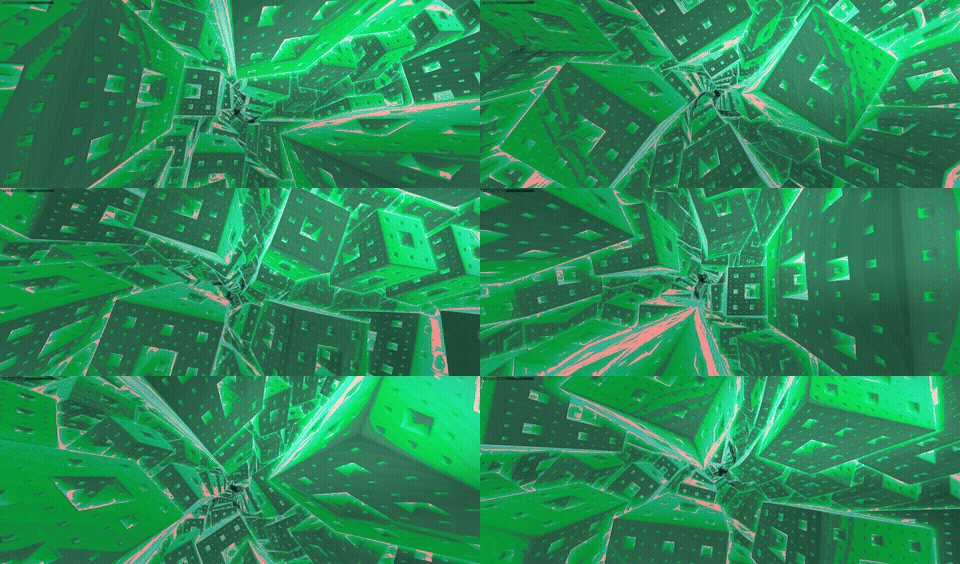
The Mandelbulb is the flagship fractal type in Fractal Forge. It is rendered using ray marching, a GPU technique where a virtual camera sends rays into the scene and steps along each ray until it hits the fractal surface. A distance estimator function — derived from the same iterative formula — tells the renderer how close each ray is to the surface, enabling real-time rendering at interactive frame rates. The power parameter controls the overall shape: a power of 8 gives the classic Mandelbulb, while lower or higher powers produce radically different organic forms.
Unlike the original two-dimensional Mandelbrot fractal, the Mandelbulb can be lit, shaded, and viewed from any angle. Fractal Forge applies ambient occlusion, specular highlights, and fog to give it physical depth, making it feel like a real object suspended in space.
Exploring Mandelbrot Fractals with Music
Fractal Forge takes the Mandelbulb — and the broader family of Mandelbrot-inspired fractals — beyond static imagery by rendering them in real time with audio reactivity. The application captures audio from your microphone or system output, performs a 2048-bin FFT analysis at 44.1 kHz, and extracts seven perceptual frequency bands from sub-bass through brilliance. These bands, along with beat detection, BPM estimation, and pitch analysis, drive 14 audio-modulated parameters that shape the fractal as the music plays.
Bass frequencies expand the fractal’s scale and tunnel radius, making it breathe in time with kick drums. Mid-range frequencies twist and wobble the geometry, adding organic motion. High frequencies increase detail and glow, while detected pitch maps to hue through a synesthesia algorithm — turning musical notes into colors. The result is a Mandelbrot fractal that genuinely dances to the music, responding not just to volume but to rhythm, melody, and harmonic content.
Fractal Forge ships with 53 fractal types, five genre-optimized presets, and full manual control over every parameter. Whether you are building fractal art for a gallery, performing live visuals at a music festival, or simply watching the Mandelbulb come alive with your favorite album, the application is designed to make the connection between mathematics and music tangible. For a deeper dive into the audio engine, visit the fractal audio visualization page.
Frequently Asked Questions
What is the Mandelbrot set?
The Mandelbrot set is a collection of complex numbers defined by the iterative formula z = z² + c. Starting with z = 0, each complex number c is tested by repeatedly applying this formula. If the value of z never escapes to infinity, c belongs to the Mandelbrot set. The boundary of this set produces infinitely detailed fractal patterns that are self-similar at every scale.
How is the Mandelbrot set calculated?
For each point c on the complex plane, you start with z = 0 and repeatedly compute z = z² + c. If the magnitude of z exceeds 2 (the escape radius) within a set number of iterations, the point is outside the set. The number of iterations before escape determines the color assigned to that point, producing the vivid fractal imagery associated with the Mandelbrot fractal.
What is a Mandelbulb?
The Mandelbulb is a three-dimensional analog of the Mandelbrot set, discovered by Daniel White and Paul Nylander in 2009. It uses triplex algebra to extend the iterative squaring formula into 3D space, producing extraordinarily detailed organic structures that can be rendered and explored from any angle using ray marching on a GPU.
What is the difference between Mandelbrot and Julia sets?
Both use the same formula z = z² + c. For the Mandelbrot set, c changes for each pixel while z starts at 0. For a Julia set, c is fixed and z starts at the pixel coordinate. Every point inside the Mandelbrot set corresponds to a connected Julia set, while points outside correspond to disconnected Julia sets.