What Is Fractal Art?
Fractal art is a genre of digital and algorithmic art built on fractal mathematics — equations that produce shapes exhibiting self-similarity at every scale. Unlike traditional visual art that begins with a blank canvas and a brush, fractal art emerges from computation. An artist sets parameters, a computer iterates equations millions of times, and the result is an image whose complexity no hand could replicate. Every zoom reveals new structure, every parameter tweak births an entirely different composition.
The roots of fractal art stretch back to the late 1970s and early 1980s when Benoit Mandelbrot first visualized the set that bears his name on early IBM hardware. Those blocky, monochrome plots captured the imagination of mathematicians and artists alike. As personal computers gained graphical power through the 1990s, hobbyists began exploring escape-time algorithms with custom color palettes, turning raw numerical output into vivid, poster-worthy images. The field evolved further when GPU programming made real-time rendering feasible, opening the door to animated and interactive fractal art that responds to user input or even live audio.
Today, fractal art occupies a unique intersection of generative art, mathematical art, and digital creativity. It appears in gallery exhibitions, album covers, music festival visuals, and VJ performances worldwide. What distinguishes fractal art from other forms of generative art is its grounding in deterministic equations: every pixel is the product of precise math, yet the visual result feels organic, alien, and endlessly surprising.
Fractal Art Gallery
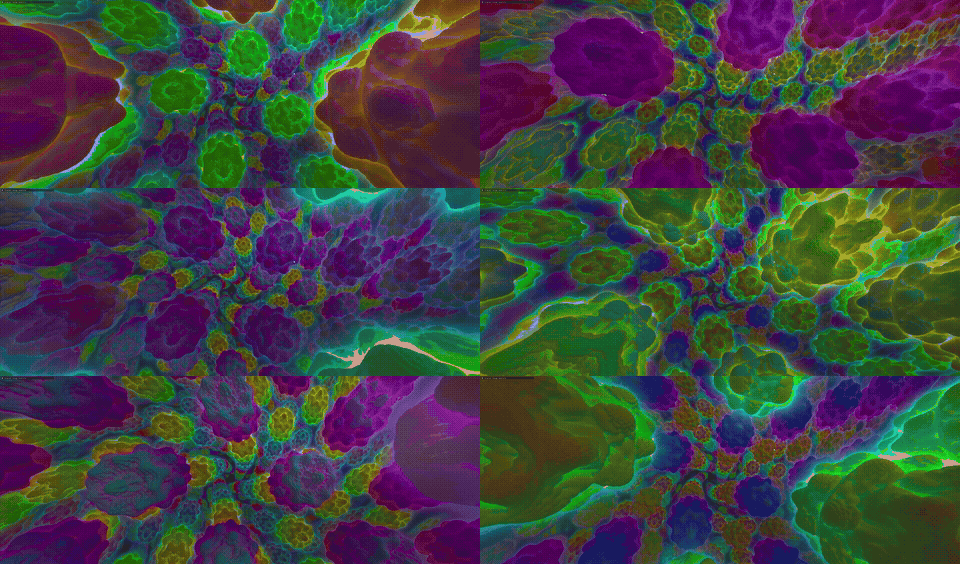
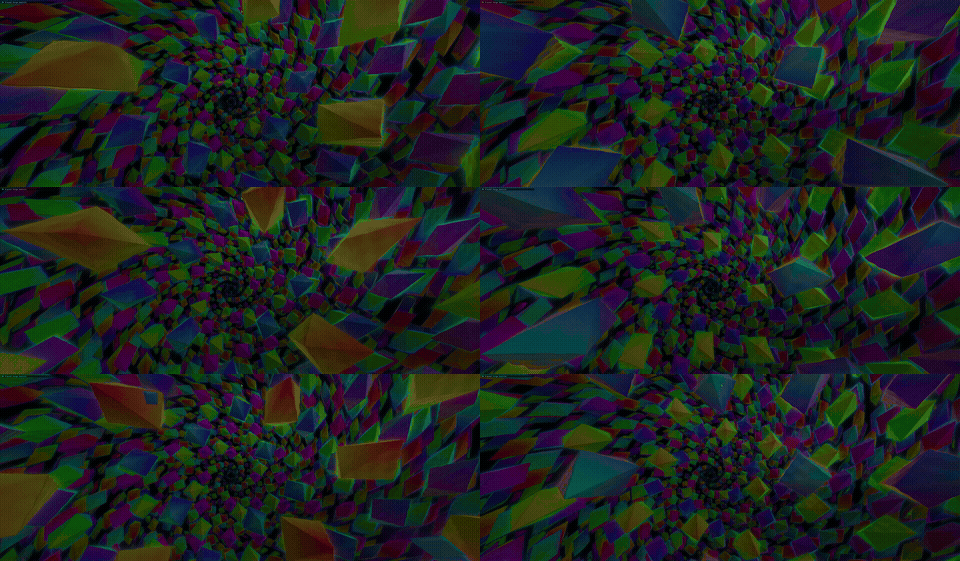
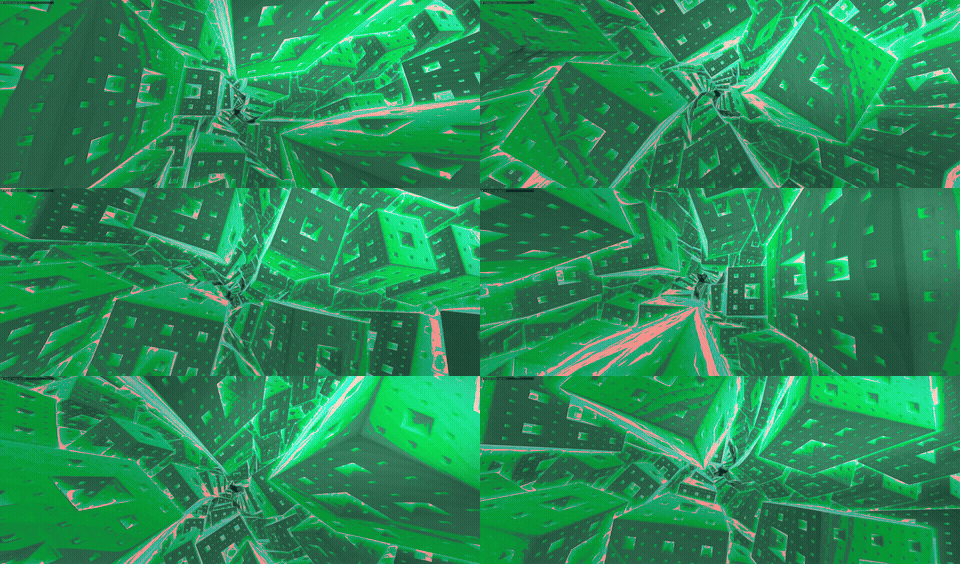
The images below are live captures from Fractal Forge Native, showing fractal art generated in real time while music plays. Each frame is the product of audio analysis driving 14 visual parameters across GPU-rendered 3D fractal geometry.
Fractal Art Techniques
Creating compelling fractal art requires more than plugging numbers into an equation. Several rendering techniques define how raw mathematical data becomes a finished visual.
Ray marching is the backbone of real-time 3D fractal visualization. Instead of rasterizing polygons, the GPU casts rays from the camera into the scene and steps forward along each ray, evaluating a distance estimation function at every point. When the estimated distance drops below a threshold, the ray has struck the fractal surface. This technique is what Fractal Forge Native uses for all 53 of its fractal types, allowing smooth camera movement through infinite three-dimensional structures at 60 frames per second.
Escape-time coloring is the classic method behind the iconic images of the Mandelbrot set and Julia sets. For every point on the complex plane, the algorithm iterates a function and records how many steps it takes for the value to escape to infinity. That iteration count maps to a color gradient, producing the swirling bands and fine filaments that define traditional 2D fractal art.
Orbit traps add artistic control to escape-time rendering. Instead of coloring purely by iteration count, the algorithm checks whether the orbit of each point passes near a predefined geometric shape — a circle, cross, or line. The distance to that trap shape becomes an additional color channel, allowing artists to embed recognizable patterns within the chaotic detail of a fractal.
Distance estimation goes hand-in-hand with ray marching. By computing an analytical or numerical estimate of how far a point is from the fractal surface, the renderer can adaptively adjust step sizes for speed and accuracy. It also enables ambient occlusion lighting, where crevices in the fractal appear darker because surrounding geometry blocks light. The combination of these techniques gives Fractal Forge its volumetric, almost photographic look.
Music-Reactive Fractal Art
Static fractal art is striking. Fractal art that moves to music is transformative. Fractal Forge Native bridges audio and visual by running a continuous analysis pipeline on live microphone or line-in audio, then mapping the results onto the visual parameters of a 3D fractal scene in real time.
The audio engine performs a 2048-bin FFT at 44.1 kHz, extracts seven perceptual frequency bands from sub-bass through brilliance, detects kicks and snares with adaptive thresholding, estimates BPM from inter-beat intervals, and identifies the dominant musical pitch via 12-tone harmonic analysis. All of this happens every frame.
Pitch-to-color synesthesia is one of the most distinctive features. The detected musical pitch maps directly to hue: C produces red, E produces green, G-sharp produces blue, and every semitone in between fills the spectrum at 30 degrees per step. When a melody ascends, the fractal shifts through the rainbow in sync.
BPM-locked animation ties the fractal’s breathing cycle — its gentle expand-and-contract pulsation — to the tempo of the music. A 120 BPM track produces one full breath every half second. The result is fractal art that feels alive, as though the geometry itself inhales and exhales with the beat.
Beat detection triggers additional visual effects: a 400-millisecond psychedelic bloom on every kick, hue shifts on snare impacts, and glow increases tied to overall RMS energy. These layers combine so the fractal art responds not just to volume but to rhythm, melody, and harmonic content — a level of audio reactivity that goes far beyond simple waveform visualizers. Explore the full audio analysis pipeline on the fractal audio visualization page.
53 Fractal Types for Artistic Expression
Fractal art is only as varied as the equations behind it. Fractal Forge ships with 53 distinct fractal types organized into several mathematical families, each offering a different aesthetic vocabulary for the artist.
Escape-time fractals include the Mandelbrot set, Julia sets, Burning Ship, Tricorn, Multibrot variations, Phoenix, Buffalo, Celtic, and Newton fractals. These are the foundational forms of fractal art, producing the intricate spirals and filigree edges that define the genre.
IFS (Iterated Function System) fractals build structure through recursive geometric transformations. Sierpinski tetrahedra, Menger sponges, Barnsley Fern, Kaleidoscopic IFS, and platonic-solid IFS types like octahedral, tetrahedral, dodecahedral, and icosahedral variants all fall into this family. Their architectural, crystalline forms make excellent subjects for fractal art with a geometric aesthetic.
Strange attractors — Lorenz, Clifford, De Jong, and Rossler — trace chaotic trajectories through space. As fractal art, they produce flowing, ribbon-like structures that feel more organic and fluid than the sharp edges of escape-time work.
Organic and sacred-geometry fractals round out the collection: Romanesco spirals inspired by the natural vegetable, Coral Growth simulations, Flower of Life, and Metatron’s Cube. These connect fractal art to both the natural world and ancient geometric traditions.
Every type responds to audio identically through the same 14-parameter modulation system, so switching fractal type mid-performance changes the artistic style without interrupting the music connection. For a deeper look at the mathematics behind these shapes, visit the what is a fractal guide.
Create Your Own Fractal Art
Getting started with fractal art in Fractal Forge takes only a few minutes. Here is a quick walkthrough.
- Download and install — Grab the latest installer from the link below. The application runs on Windows 10 and 11 with any GPU that supports OpenGL 4.3 or higher.
- Pick a fractal type — Open the control panel and browse the 53 available types. Start with the Mandelbulb or Julia Set 3D for classic fractal art, or try Kaleidoscopic IFS for something more abstract.
- Play music — Enable audio input, grant microphone permission, and start playing any song. The fractal art will immediately begin responding to frequency, rhythm, and pitch.
- Capture your art — Press the S key to save a high-resolution screenshot at any moment. For moving fractal art, use the built-in video export to record directly to an MP4 file.
- Experiment — Adjust the smoothing slider to control how fluidly the fractal art reacts. Try different genre presets (Electronic, Ambient, Rock, Classical, Hip-Hop) to change the visual personality. Use the R key to randomize parameters for unexpected compositions.
Whether you are a digital artist exploring generative art, a VJ preparing festival visuals, or simply someone who wants to watch beautiful mathematical art dance to your favorite playlist, Fractal Forge makes fractal art creation accessible and immediate.
Frequently Asked Questions
What is fractal art?
Fractal art is a form of algorithmic and generative art created by calculating fractal mathematical objects and representing them as images, animations, or other visual media. Artists use software to explore parameters like zoom depth, color mapping, and iteration counts to produce visuals with infinite detail and self-similar patterns.
How do you create fractal art?
You create fractal art by using specialized software that computes fractal equations and renders them visually. The artist selects a fractal type, adjusts parameters such as color palettes, iteration depth, and zoom level, and then captures or exports the result. Tools like Fractal Forge Native let you generate fractal art in real time using music as an input.
What software makes fractal art?
Several programs create fractal art. Fractal Forge Native is a real-time music-reactive fractal visualizer for Windows with 53 fractal types and GPU-accelerated rendering. Other well-known tools include Mandelbulb 3D for static 3D fractals and Ultra Fractal for 2D exploration. Fractal Forge stands out by generating fractal art that responds to live audio in real time.
Can music create fractal art?
Yes. Fractal Forge Native analyzes audio in real time using 7-band frequency analysis, beat detection, and pitch tracking to modulate 14 visual parameters of a fractal scene. Musical pitch maps to color through synesthesia, BPM locks to breathing animations, and beat impacts trigger visual blooms — creating fractal art that dances to rhythm and melody.